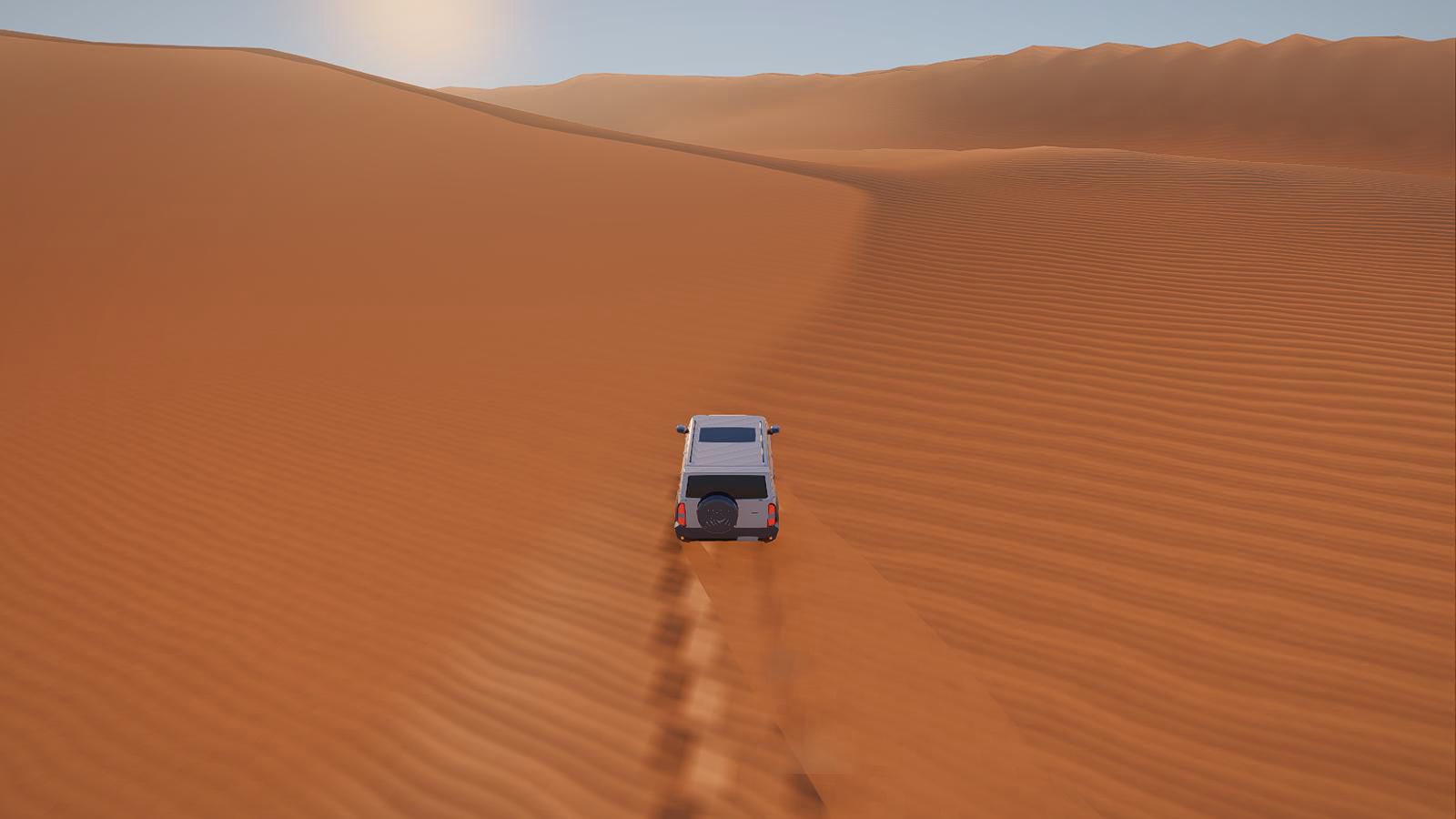
Our own product, in development: a calm 4×4 dune-driving game set in three real UAE deserts. No race clock by default — just dunes, light and nine flags to find while the sun goes down. Built because real-time 3D and physics on hardware we don’t control is the same skill set as a digital twin or a training simulator.
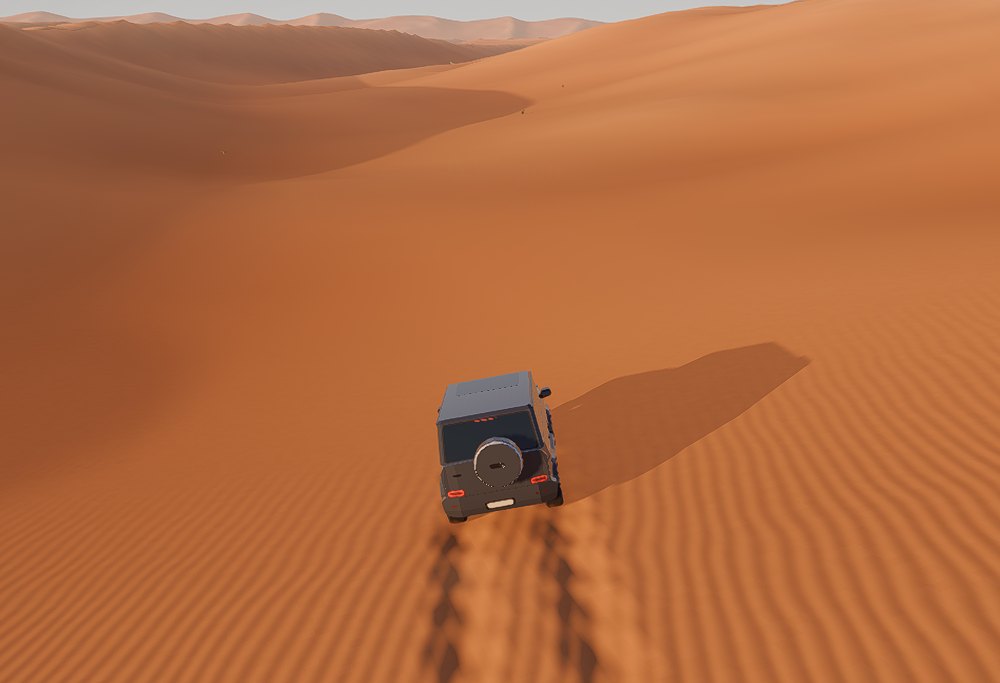
We wanted a driving game that feels like a real afternoon in the UAE dunes, not a race across generic orange sand — and it had to run smoothly on an ordinary Android phone.
That is a harder brief than it sounds. Large open terrain, sand that changes under the wheels, light that moves, and vehicles that behave like their real counterparts all compete for the same few milliseconds per frame, on hardware we don’t choose.
It is also exactly the problem behind digital twins, site visualisation and training simulators. Building our own product is how we keep those skills sharp.
Three real deserts, each with its own character. Al Qudra is pale and gentle. Big Red, at Lahbab, is rust-red with a 58 m great dune. Liwa, on the edge of the Empty Quarter, has an 85 m great dune and salt flats.
Each location covers 9 km² and has its own dune height and spacing, sand colour and sun angle. Native plants — ghaf, markh and arta — are placed by habitat rather than scattered at random. Slopes are capped at sand’s angle of repose, about 33°, and the colours were matched to real dune photographs.
The default mode is Wander: no clock, nine flags to find while the sun sets over about twelve minutes, ending on a card of the route you drove. A contest mode puts you against four bot drivers.
The game is still in development. Today it runs at 60 fps on our Android test phone and as a Windows build, from about 16,000 lines of code on Godot 4 and C#. There is also a downtown city mode, built from OpenStreetMap data.
For clients, the point is the capability: large real-world environments, physics and moving light rendered in real time on devices nobody can standardise. That is what a plant digital twin, a site walkthrough on a tablet or a training simulator needs.
Sixty frames a second,
on hardware we don’t control.
A site, a plant or a procedure
you need to walk through on a tablet?