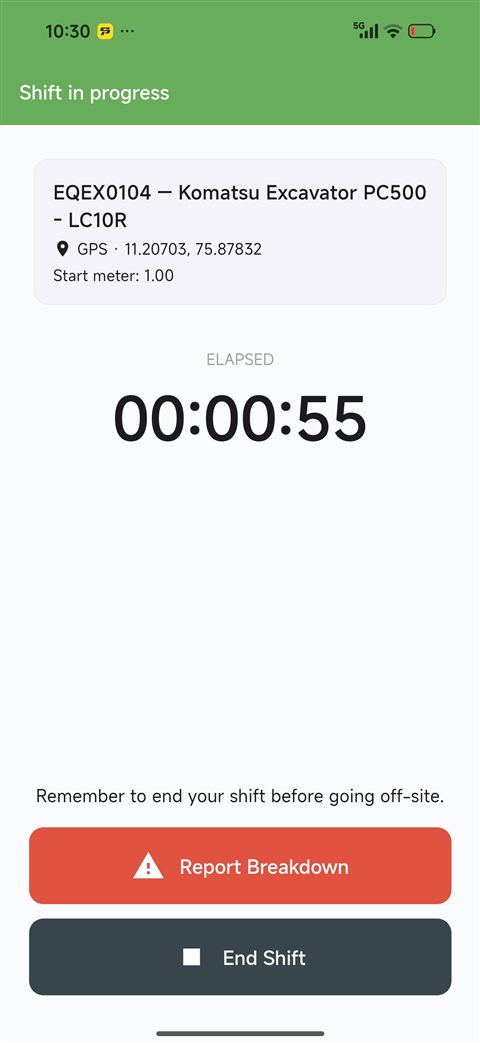
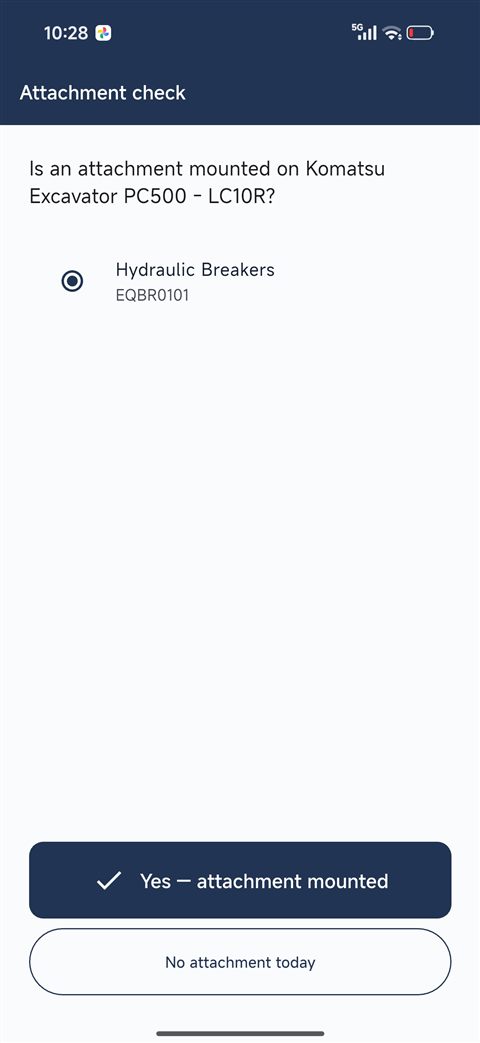
Force tracks shifts, machine hours, attachment usage and breakdowns for heavy equipment fleets — excavators, breakers, loaders — from operator phones to a central admin dashboard. It is built for the environment it actually runs in: patchy connectivity, shared handsets, and a genuine financial incentive to overstate hours. Every integrity guarantee is enforced server-side, where the handset cannot reach it.
Plant hire is billed on machine hours. Machine hours were being recorded on paper, by the operator, at the end of a shift, and keyed in days later by someone in an office who had no way to verify any of it. The gap between what was recorded and what actually happened was pure margin leakage — and nobody could size it, because there was no ground truth to compare against.
The obvious fix — "give operators an app" — fails immediately in this environment. Sites have no reliable data connection. Handsets are shared and cheap. And crucially, the person entering the data is the person whose pay it affects. An app that simply accepts typed input digitises the problem rather than solving it.
Off-the-shelf telematics wasn't an option either: it assumes OEM hardware on every machine and a per-asset subscription. The fleet was mixed, nobody was going to retrofit it, and the operational history needed to stay under the client's own control.
We treated anti-fraud as an architectural requirement, not a feature. The design principle: never trust a claim the client app makes about itself. Every guarantee is re-established somewhere the operator's handset cannot reach.
Location is checked against the site's geofence on the server, using proper geospatial queries rather than a distance calculation the app could be persuaded to lie about. An out-of-zone shift is rejected and recorded in an audit trail, not silently accepted. Uploaded photographs are validated by inspecting the file itself rather than trusting what the client says it is. Shift duration is measured against a clock the user cannot wind forward.
The strongest guarantee is the quietest one: the impossible states are made impossible in the data model, not merely checked for in application code. A machine cannot be on two shifts, and an operator cannot be running two machines — not because a validation rule says so, but because the schema will not represent it. Taking over a machine from another operator is an explicit, audited action.
Offline is the default assumption, not a degraded mode. Writes queue locally and drain when connectivity returns, on a schedule, and when the app resumes. An operator can work a full shift in a dead zone and the record arrives intact when they drive back into coverage.
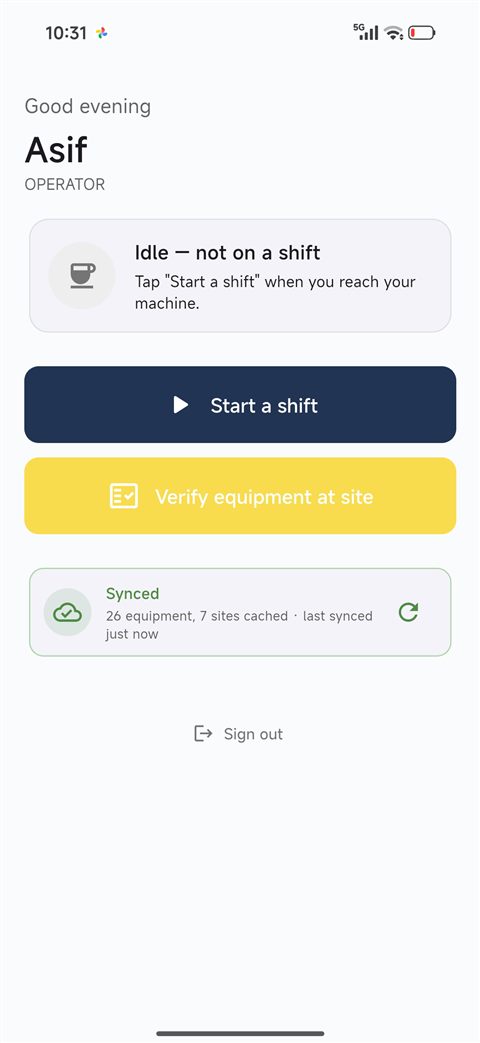
Machine hours now arrive with a GPS fix, a timestamped meter photograph, a typed reading validated against the previous one, and a monotonic elapsed time — captured at the machine, by the operator, at the moment it happened. Billing rests on evidence rather than recall.
Because breakdowns are reported from the same app with photos attached, maintenance gets a structured fault history per asset for the first time — the raw material for exactly the kind of predictive-maintenance modelling we've built elsewhere.
And the whole system runs on infrastructure the client controls, portable by design, with an English-only v1 already prepared for Arabic and Hindi. No per-asset subscription, and no vendor holding their operational history.
A control an operator can bypass
is a control you don't have.
If your operational truth lives on paper,
you are pricing on a guess.