
Motive answers three questions about right now: what this moment is like, whether it is a good time for the thing you want to do, and if not, when. Most apps answer with a single score. Motive never averages: it keeps what supports and what opposes an activity as separate channels, and shows the contradiction as the finding. All of it is computed on the user’s own device.
Apps that judge the quality of a moment almost always reduce it to one number. A single score averages away the thing that carries the meaning: when a moment is strongly favourable and strongly obstructive at once, a good time to analyse a deal and a bad time to sign it, the average describes no real state at all.
They also tend to want the most personal data a person has, their date, time and place of birth, sent to someone else’s server, and they speak in a jargon most people cannot check.
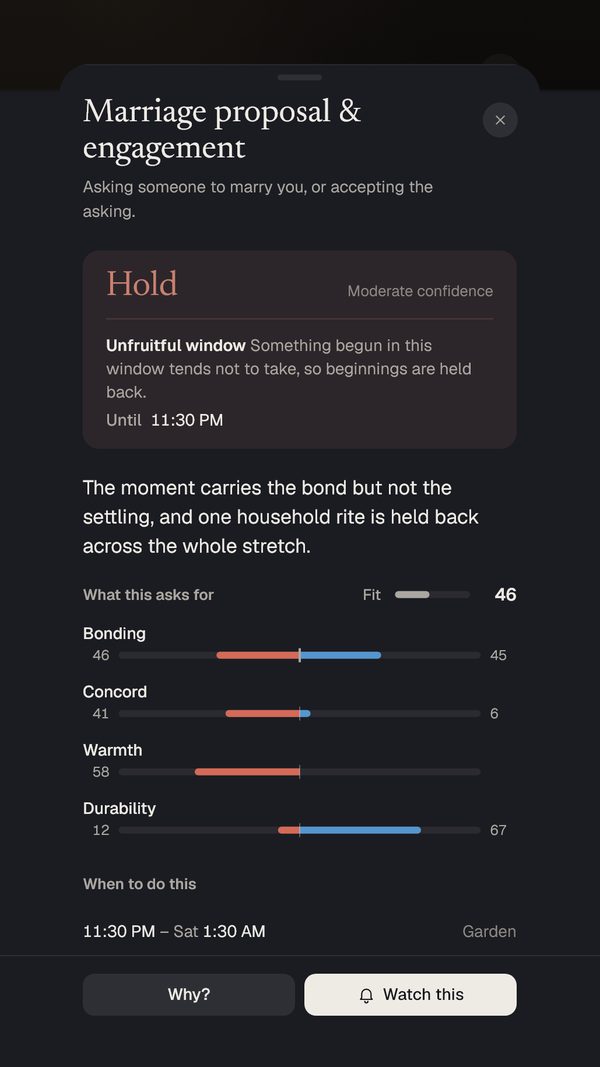
Support and opposition travel as separate channels from the astronomy all the way to the pixel. Ask about an activity and Motive says go, hold or wait, shows what pulls each way, explains why, and says when the window opens.
The computation runs where the data is: an astronomical core in C (Swiss Ephemeris) and an inference engine compiled to WebAssembly, in the browser or in the Android app. No server ever receives birth details.
The knowledge is authored from the classical texts, with each rule cited to its source and checked by a blind judge against those sources. The surface stays in plain language, with numbers the user can check and a “Why?” on every answer.
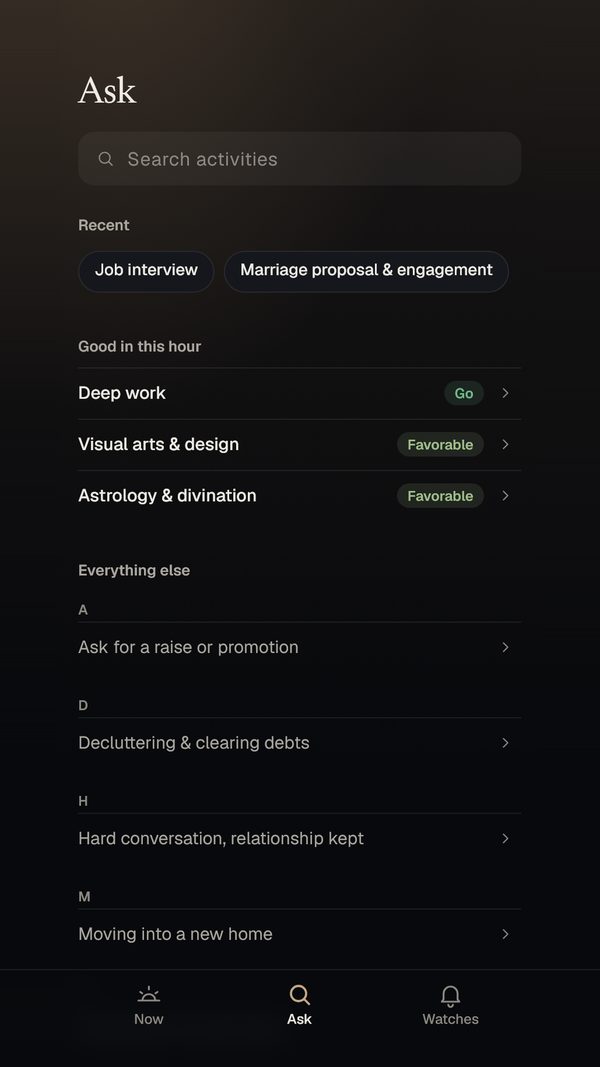
Motive is live on the web and as an Android app, with a day view that shows the quality of each part of the day, activity cards that show the pull in each direction, and an Ask screen for any activity. The engine is in active development, with each change judged blind against its sources before it ships.
The architecture is the reusable part: compute on the device, verify every deploy, and never let a single number hide what the data actually says.

A single number reports the average
and describes no real state.
Need the computation to happen
where the data already is?